INTER-MOUNTAIN WATERSHED DISTRICT
  • Home
  • Maps
  • Programs Offered
  • For Producers/Landowners
  • Completed Projects
  • Education
  • Events Calender
  • Blog
  • Contact
    • Board & Sub-District
  • Home
  • Maps
  • Programs Offered
  • For Producers/Landowners
  • Completed Projects
  • Education
  • Events Calender
  • Blog
  • Contact
    • Board & Sub-District

Maps

  • Watershed Maps
  • Dauphin Lake IWMP
  • East Duck Sagemace Bay IWMP
  • LiDAR
<
>
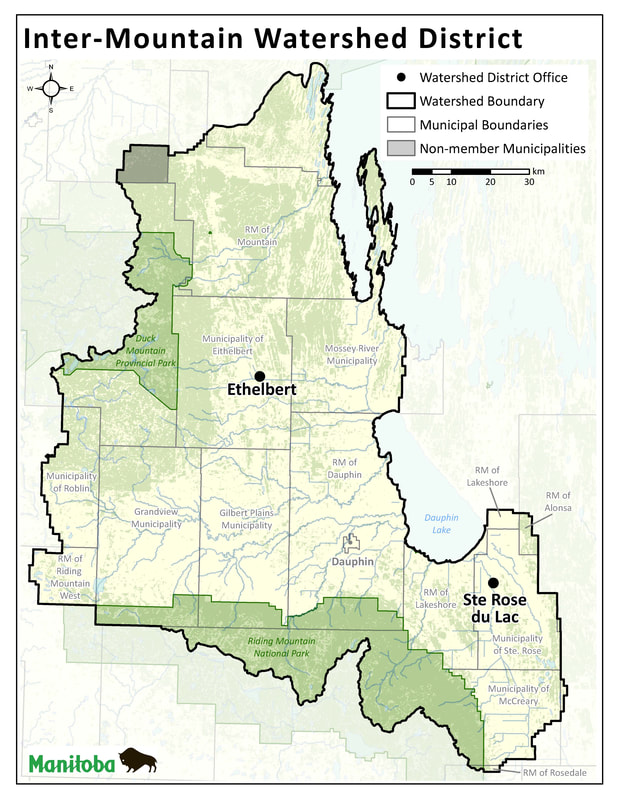
Did you know we encompass 14 municipalities, covering more than 2x the area of Prince Edward Island?

IMWD Boundary 

Being one of the largest Watershed Districts in Manitoba, Inter-Mountain Watershed District covers a total of 12,508 km² of diverse topography. The district includes Pine River, Sclater River, Duck River, Fishing Rivers, and Mossey River subwatersheds which flow to Lake Winnipegosis and the Mink Creek, Valley River, Wilson River, Vermillion River, Edwards Creek, Ochre River, and Turtle River subwatersheds which flow to Dauphin Lake. 
Picture

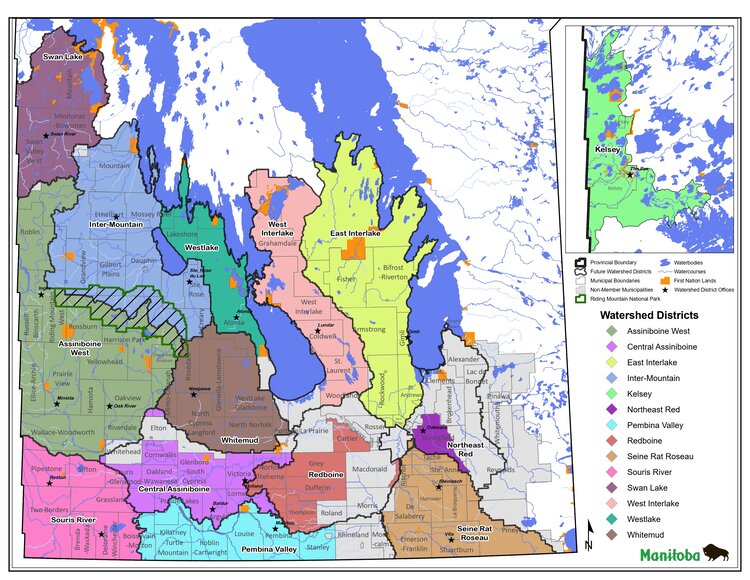
Watershed Districts in Manitoba

​On January 1st, 2020, Manitoba’s 18 conservation districts became 14 watershed districts with the proclamation of the Watershed Districts Act. To reflect this change, Manitoba Conservation Districts Association (MCDA) has changed its name to the Manitoba Association of Watersheds (MAW).
Picture

What is a IMWP? 

An integrated watershed management plan outlines actions to address priority land and water resource issues on a watershed basis. The plan is a tool to assist residents, stakeholders and all levels of government in making responsible decisions on how to manage water, develop land and allocate resources within the watershed. Each stakeholder in the watershed has a role in ensuring that this watershed plan is successfully adopted and implemented. 

Dauphin Lake IWMP 

One of the largest watersheds in southern Manitoba.
Covering 3,250 sq. mi (8,414km²)

Key outcomes of: 
  • An Emergency spillway for Dauphin Lake
  • Rehabilitated streams, alluvial fans and other natural areas
  • temporary and permanent water retention
  • Enhanced protection and public awareness
Priorities of: 
  • Surface Water Management
  • Healthy Fisheries and Wildlife Habitat 
  • Drinking Water Quality and Quantity
Picture
Diverse Topography such as: 
  • Forested upland plateaus 
  • Slopes from  the Riding and Duck Mountains
  • Lowland lake plains
  • Mixture of Agriculture, forests, and wetlands surrounding Dauphin Lake

To read the full Dauphin Lake IMWP, click on the file below!

Dauphin Lake IWMP

East Duck Mountain - Sagemace Bay IWMP


Approximately 1,660 sq. mi (4,300km²) in size.
The Primary land cover is Forest (combination of Deciduous, Mixed wood, Coniferous)
Using satellite imagery: 
  • Annual Cropland covers 9% (38,667 hectares) 
  • Grassland/pasture covers 16% (69,613 hectares).
  • Forages (mostly alfalfa) covers 5%. 
  • Marshes, fens, and open water cover 8% (35,357 hectares). 
Did you Know? 
The East Duck Mountain - Sagemace Bay Watershed is the steepest sloping watershed in Manitoba.  It ranges from the highest point in Manitoba, Baldy Mountain (832 metres above sea level) to Lake Winnipegosis (254 metres above sea level). 

3 Goals: 
  1. Reduce the impacts of overland flooding.
  2. Protect and improve surface water quality.
  3. Protect drinking water
Picture
To read the full East Duck Mountain - Sagemace Bay IMWP, click on the file below! 
East Duck Mountain - Sagemace Bay IWMP

LiDAR- Light Detection and Ranging Technology

Inter-Mountain Watershed District (IMWD) has embarked on a project to collect highly accurate topographical data for our entire area. In spring of 2021, Attlis Geomatics flew over our fourteen municipalities, collecting data using Light Detection and Ranging (LiDAR) technology.
9365 sq. km in area
Approx. 13% of Agro-Manitoba's land base
Ground Elevations for the whole Inter-Mountain Watershed District
Total Cost- $266,173 

What is LiDAR? 

Lidar is a method for determining ranges by targeting an object with a laser and measuring the time for the reflected light to return. The Lidar calculates land surface topography by emitting light beams from the plane, and then measuring the time it takes to reflect off he ground surface and return to the plane. 
​

After the LiDAR data is processed, we will have accurate digital surface elevations for all land within our District. IMWD and our partner municipalities will then use the processed data for surface water management planning, enabling us to make proactive decisions for better protecting our area from flood damages. A good example of this would be using the data to find the most cost-efficient place to build upstream water retention, in order to protect the downstream infrastructure from washing out during a flood.
Picture

Benefits of LiDAR data

We will have accurate digital surface elevations for all land within our District. IMWD and our partner municipalities will then use the processed data for surface water management planning, enabling us to make proactive decisions for better protecting our area from flood damages.
​

 A good example of this would be using the data to find the most cost-efficient place to build upstream water retention, in order to protect the downstream infrastructure from washing out during a flood. Some other examples include: 
  • Project planning 
  • Cost-benefit; cut back on in-field costs
  • Culvert Inventory
  • Classifying existing wetlands
  • Enhanced surface water management plan
Picture
Picture
